Registered forecast
50% registered probability event by 2027-02-28 Unresolved
FDA approves AD109 (aroxybutynin and atomoxetine) for obstructive sleep apnea on or before the disclosed PDUFA goal date of 2027-02-28
FF-059 Registered - Registered probability
- 50%
- Decision by
- 2027-02-28
- Reading window
- 2026-10-22 → 2027-02-28
- Decision stage
- 5 Guideline
- 6 Regulatory
- 7 Coverage
- Baselines it has to beat
-
- Authority base rate 70%
- Calendar cycle 75%
- Analyst proxy 55%
nextconsensus.com/forecast/ff-059/ registry snapshot 2026-11-07 Share image
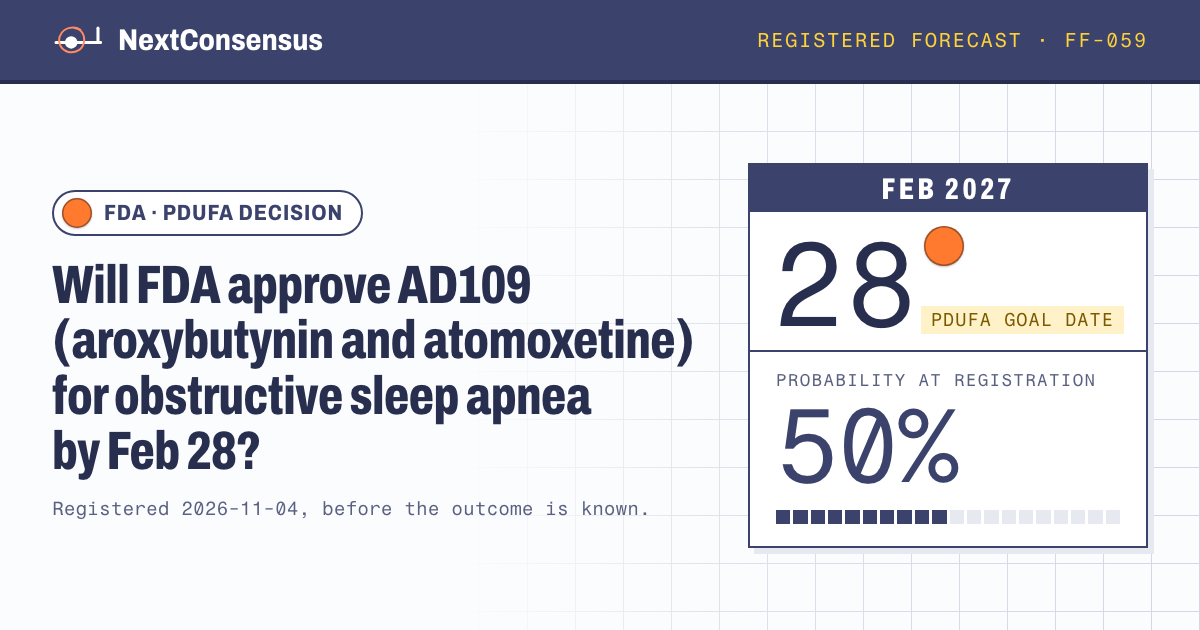
NextConsensus registered this probability on 2026-11-04. It is one of 35 registered FDA goal-date forecasts.
The proposition
What was registered
The FDA takes an approval action on Apnimed’s New Drug Application for AD109 (aroxybutynin and atomoxetine; proposed proprietary name Oxnimbi) for the treatment of adults with obstructive sleep apnea, with an approval action date on or before 2027-02-28, the PDUFA target action date disclosed in Exhibit 99.1 to Apnimed’s Form 8-K filed 2026-09-08.
- Who decides
- US Food and Drug Administration (FDA), Center for Drug Evaluation and Research (CDER) (US)
- Decision stageThe kind of body that has to act: a guideline panel, a regulator, or a payer. The ladder, rung by rung
- Rung 6: Regulatory action — Label/indication change, approval action, REMS modification, or withdrawal by FDA, EMA, PMDA, Health Canada, etc.
- Decision typeThe type of decision this forecast is counted with, such as FDA actions by their goal dates
- FDA action by goal date
- Scope
- Obstructive sleep apnea in adults
The estimate
The number and the baselines it has to beat
The estimate that the named body takes the action by the deadline, from what was public at the cutoff.
The alternatives it was registered against, each with the reasoning that produced it. They were set at registration: how often this kind of decision happens on time, what the calendar alone suggests, and a reading of the same public record without this method. Each one's reasoning shows whether it is a count of past decisions or an estimate.
ESTIMATE FROM THE SHAPE OF THE CLASS, NOT AN ENUMERATED COUNT. Original NDAs on standard review backed by two positive phase 3 trials are approved at their first goal date in most cases, with first NDAs from small sponsors and new-mechanism indications at the lower end. The calendar’s own met-goal-date share for disclosed PDUFA dates does not exist yet (docs/foundations/short-horizon-reference-classes.md §4.1).
A clock-only model: the goal date is inside the window, FDA meets most goal dates, and most first-cycle actions on original NDAs are approvals. With no evidence input it cannot tell a strong application from a weak one.
An analyst reading the same filings on 2026-10-21 would weigh two phase 3 trials of about 1,300 patients that met their primary endpoint, Fast Track designation and no approved therapy with this mechanism, against FDA’s pre-filing concern about the clinical meaningfulness of the primary endpoint and the patient-reported outcomes, a first NDA from a newly public sponsor, and a new mechanism in a large chronic indication. Estimated by reconstructing that read, not by surveying analysts.
Regulatory action (FDA): offered on judgment, with no calibration figure until 15 in the class have resolved.
The method and every record are public, so you can check the work.
The clock
Dates that constrain the record
- Evidence as of
- 2026-10-21
Nothing after this date informed the estimate. - Registered
- 2026-11-04
Frozen and hashed. - Reading window
- 2026-10-22 → 2027-02-28
When the outcome can be read against the rule. - Event by
- 2027-02-28
The final qualifying action date; the frozen resolution rule defines what counts. Add to calendar
d705fe110336e0a1ea701ecb52bcdf3072c7a7786d4db79481dd12854efc3fc3 · operator record jc-1793799251604-d0b82e14 Around this record
- This kind of deadline
- Check it, follow it
Confidential Asset & Milestone Evaluation
Evaluating an asset or milestone that the FDA could move?
Name the asset, the deciding authority, and the date your team commits to: a P&T review, an HTA submission, a label negotiation, a deal closing, or a milestone dispute. Your stake need not be direct sponsorship — an asset you evaluate, finance, advise on, or rely upon is enough. Every commercial evaluation applies the same rigorous pre-registration and primary-source verification shown on this page, delivered privately under mutual NDA.
Resolution
The rule that settles the forecast
The application number was not public at the cutoff, and openFDA held no record for aroxybutynin (SRC-003, SRC-004). The adjudicator identifies the qualifying approval by its indication plus its ingredients, never by a name the adjudicator infers: an approval action whose Drugs@FDA approval letter or label names obstructive sleep apnea in its indication, for a product whose active ingredients are aroxybutynin (or a salt of it) together with atomoxetine (or a salt of it) in one product, under any applicant (Apnimed, Inc or an Apnimed subsidiary) and any proprietary name. Resolves YES if the openFDA Drugs@FDA records returned by https://api.fda.gov/drug/drugsfda.json?search=products.active_ingredients.name:%22AROXYBUTYNIN%22&limit=100 and by https://api.fda.gov/drug/drugsfda.json?search=openfda.generic_name:%22aroxybutynin%22&limit=100, read together (openFDA does not always fill the generic-name field for a new application), contain such an approval: an application whose ORIG submission has submission_status AP and a submission_status_date on or before 2027-02-28. An approval for a narrower obstructive sleep apnea population than the applicant sought (by severity or body mass index, for example) still resolves YES. A tentative approval does not count. Resolves NO if no approval action is dated on or before 2027-02-28: a complete response letter, a goal-date extension, withdrawal or no action. The goal date is frozen as disclosed at the cutoff; a later extension does not move it, and an approval dated after 2027-02-28 resolves NO as occurred_after_deadline. 2027-02-28 is a Sunday; an approval action dated that day, or earlier, counts. Read no earlier than 2027-03-14. If openFDA has not refreshed by then, or both queries return nothing, the Drugs@FDA web record (https://www.accessdata.fda.gov/scripts/cder/daf/, searched by the names aroxybutynin and Oxnimbi) governs, under the same identification test. Resolves unresolvable only if none of these sources can be read after the read floor. Resolves VOID, with the reason recorded, only if FDA withdraws every public record of approval actions named above without an equivalent public successor, so that no approval date for this product can be read; while any of them publishes it, the rule stands.
Source the rule names: https://api.fda.gov/drug/drugsfda.json?search=openfda.generic_name:%22aroxybutynin%22&limit=100, https://api.fda.gov/drug/drugsfda.json?search=products.active_ingredients.name:%22AROXYBUTYNIN%22&limit=100, https://www.accessdata.fda.gov/scripts/cder/daf/
Readers: Resolver A, clinical methodology; Resolver B, payer evidence. The same two reader roles are assigned to every forecast registered so far.
What this record will show once it resolves
Beside every result, the count for its class (FDA action by goal date): registered, resolved, unresolved, and expired. One forecast is one instance, not a rate.
- The finding
- As the rule above reads it: occurred on time, did not occur, or left unscored.
- The readers and their sources
- Two reader roles read the source named above: Resolver A, clinical methodology; Resolver B, payer evidence. Who adjudicated it is named here, with the sources they read when the adjudication lists them. Being named as a reader means applying the frozen rule to the public record; it is not support for the estimate, the method, or NextConsensus.
- The number against its baselines
- 50% beside three baselines, each scored by the same rule (squared error), so a reader can see how the record did against each of them.
Reasoning
What the number rests on
The facts it was built from are below, as they stood at the cutoff, with every source archived; each baseline above carries the reasoning that produced it. The written mechanism and the conditions that would make the proposition ill-posed were frozen with the record and are held in the ledger, which the hash on this page covers.
Frozen covariatesThe facts about the evidence and the authority's process that were frozen with the forecast at its cutoff
The state of the record at the cutoff
Recorded as they stood on 2026-10-21.
- review pathway
- Standard review: a 10-month review cycle from the April 2026 submission (SRC-002). Fast Track designation since May 2022 (SRC-002). Submitted under section 505(b)(2) (SRC-002). Center CDER is the drafter’s understanding (a small-molecule NDA), unverified.
- submission type
- Original NDA for a fixed-dose combination of aroxybutynin and atomoxetine in OSA (SRC-001, SRC-002); first review cycle; application number not public, and openFDA holds no record for aroxybutynin (SRC-003, SRC-004).
- evidence class
- Two completed randomized, double-blind, placebo-controlled, parallel-arm phase 3 trials, SynAIRgy and LunAIRo, in adults with mild to severe OSA, both meeting the primary endpoint (SRC-002).
- pivotal n
- about 1,300 across the two phase 3 trials (SRC-002)
- endpoint type
- Physiological polysomnography endpoint: reduction in apnea-hypopnea index at week 26 (primary); hypoxic burden and patient-reported outcomes among secondaries, whose clinical meaningfulness FDA questioned (SRC-002).
- approved competitors in class
- None with this mechanism stated. Zepbound (tirzepatide) was approved in December 2024 for moderate-to-severe OSA in adults with obesity (SRC-002).
- months since last guideline revision
- not applicable — no guideline is the subject of this proposition
- panel cycle position
- not applicable — the act is an FDA approval action
- sponsor request status
- NDA submitted April 2026, accepted July 2026, PDUFA target action date 2027-02-28 (SRC-001, SRC-002).
- odac referral
- none announced in the archived sources
- sponsor state change
- Initial public offering completed in 2026 for gross proceeds of 220.8 million dollars; a planned leadership transition appointed a new chief executive, chief financial officer and chief legal officer (SRC-001).
Sources
Everything the estimate was built from
Each was retrieved on or before the 2026-10-21 cutoff and archived at the digest shown. If a publisher edits a page after the fact, the digest stops matching and the substitution is visible.
-
SRC-001Apnimed Form 8-K Exhibit 99.1, filed 2026-09-08: Q2 2026 results release. FDA accepted the NDA for AD109 (aroxybutynin and atomoxetine, proposed proprietary name Oxnimbi) for adults with obstructive sleep apnea and assigned a PDUFA target action date of February 28, 2027; pooled SynAIRgy and LunAIRo analyses presented; IPO completed for gross proceeds of 220.8 million dollars; new chief executive, chief financial officer and chief legal officer appointed in a planned leadership transition. -
SRC-002Apnimed Form 10-Q for the quarter ended 2026-06-30, filed 2026-09-08: NDA submitted April 2026 under section 505(b)(2), accepted July 2026, 10-month review to the 2027-02-28 goal date; SynAIRgy and LunAIRo (about 1,300 patients) met the primary endpoint, with week-26 apnea-hypopnea index reductions of 44.1% and 33.7% against 17.6% and 7.3% on placebo; FDA, reviewing the topline data, expressed concerns about the clinical meaningfulness of endpoint results including the primary endpoint and the limitations of the patient-reported outcomes; Fast Track designation since May 2022; Zepbound approved for OSA in obesity in December 2024. -
SRC-003openFDA drugsfda products.active_ingredients.name:"AROXYBUTYNIN", retrieved 2026-10-21: 404 No matches found. No application for the ingredient. -
SRC-004openFDA drugsfda openfda.generic_name:"aroxybutynin", retrieved 2026-10-21: 404 No matches found.