Registered forecast
88% registered probability event by 2027-07-31 Unresolved
FDA approves a first-line indication for sunvozertinib in EGFR exon 20 insertion NSCLC
FF-002 Registered - Registered probability
- 88%
- Decision by
- 2027-07-31
- Reading window
- 2026-09-23 → 2027-07-31
- Decision stage
- 5 Guideline
- 6 Regulatory
- 7 Coverage
- Baselines it has to beat
-
- Authority base rate 85%
- Calendar cycle 70%
- Analyst proxy 90%
nextconsensus.com/forecast/ff-002/ registry snapshot 2026-11-07 Share image
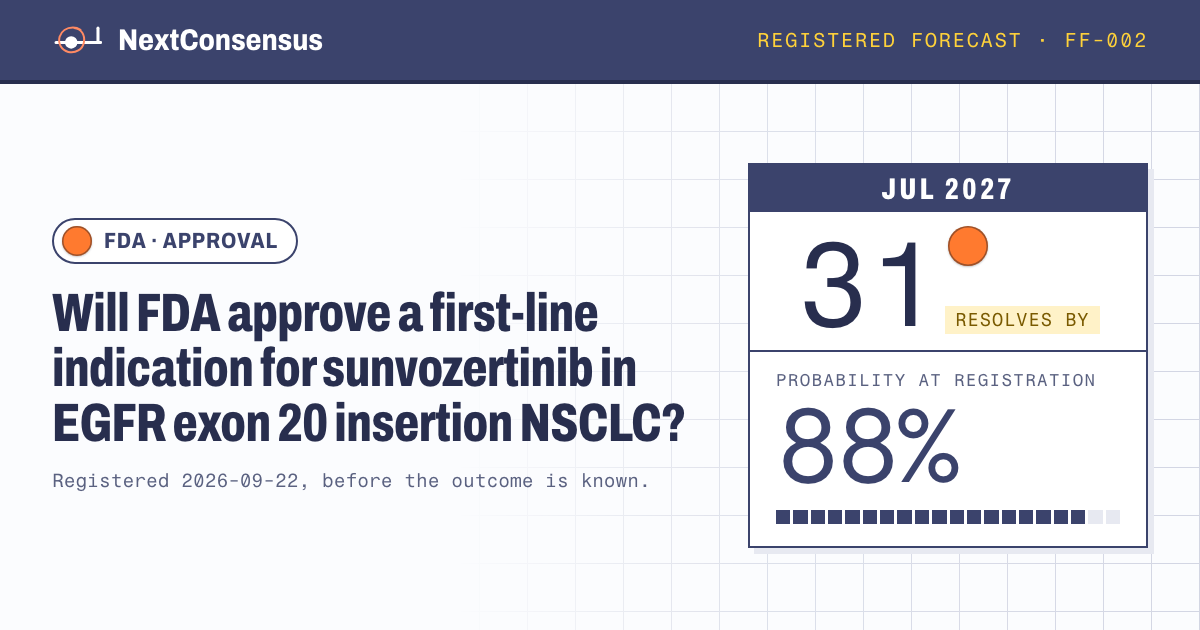
NextConsensus registered this probability on 2026-09-22. It is one of 65 registered forecasts.
The proposition
What was registered
The FDA approves a first-line / initial-treatment indication for sunvozertinib (ZEGFROVY) in EGFR exon 20 insertion mutation-positive locally advanced or metastatic non-small cell lung cancer, expected as a supplement to NDA 219839, with an approval action dated on or before 2027-07-31.
- Who decides
- US Food and Drug Administration (FDA), Center for Drug Evaluation and Research, Office of Oncologic Diseases (US)
- Decision stageThe kind of body that has to act: a guideline panel, a regulator, or a payer. The ladder, rung by rung
- Rung 6: Regulatory action — Label/indication change, approval action, REMS modification, or withdrawal by FDA, EMA, PMDA, Health Canada, etc.
- Decision typeThe type of decision this forecast is counted with, such as FDA actions by their goal dates
- FDA label revision
- Scope
- EGFR exon 20 insertion mutation-positive locally advanced or metastatic NSCLC
The estimate
The number and the baselines it has to beat
The estimate that the named body takes the action by the deadline, from what was public at the cutoff.
The alternatives it was registered against, each with the reasoning that produced it. They were set at registration: how often this kind of decision happens on time, what the calendar alone suggests, and a reading of the same public record without this method. Each one's reasoning shows whether it is a count of past decisions or an estimate.
Reference class: FDA efficacy supplements adding a line of therapy, supported by a randomized phase 3 that met its primary endpoint and carrying Breakthrough Therapy Designation, approved within eleven months of acceptance. Supplements that reach filing are approved at a high rate and the large majority act within one goal-date cycle. Estimated from the shape of that reference class, not from an enumerated count — the enumerated corpus for rung 6 is the object of the proof cycle and, per the repo's own fda-label-v1-invalidation review under workspace/reviews/ (a review of this repo's backtest, not a source fact), the one that existed was not usable. Recorded as the honest state of this baseline at the cutoff.
A model that knows only PDUFA clocks and nothing about the evidence. An accepted efficacy supplement has a goal date 6 months (priority) or 10 months (standard) from the 60-day filing date; from an acceptance no later than 2026-09-01 both land before 2027-07-31, so the probability that a decision of some kind falls inside the window is near 1. Having no evidence input, such a model cannot discriminate between a strong and a weak application and defaults to the unconditional probability that a filed efficacy supplement is approved at its first goal date. The output is the product of those two.
A thoracic-oncology analyst reading the same public record on 2026-09-04 — NEJM-published positive phase 3 against platinum doublet, Breakthrough Therapy Designation in this setting, supplement accepted, and a large pharmaceutical company paying $600m upfront for global rights seven weeks before the license completed and the acceptance was announced — would call first-line approval highly likely and treat the goal date as the only real question. Estimated by reconstructing that read, not by surveying analysts.
Regulatory action (FDA): offered on judgment, with no calibration figure until 15 in the class have resolved.
The method and every record are public, so you can check the work.
The clock
Dates that constrain the record
- Evidence as of
- 2026-09-22
Nothing after this date informed the estimate. - Registered
- 2026-09-22
Frozen and hashed. - Reading window
- 2026-09-23 → 2027-07-31
When the outcome can be read against the rule. - Event by
- 2027-07-31
The final qualifying action date; the frozen resolution rule defines what counts. Add to calendar
56015937eab42488ee1a6706401594c56146be557f1536688ff27c3835e0b2c5 · operator record jc-1790109834676-bf6924d6 Around this record
- Sunvozertinib · first-line NSCLC
-
- FF-003 · Sunvozertinib · first-line approval by March event by 2027-03-31
- FF-001 · Sunvozertinib · first-line guideline listing event by 2027-07-31
- FF-004 · Sunvozertinib · FDA approval before NCCN listing event by 2027-07-31
- This kind of deadline
- The evidence
- Check it, follow it
Confidential Asset & Milestone Evaluation
Evaluating an asset or milestone that the FDA could move?
Name the asset, the deciding authority, and the date your team commits to: a P&T review, an HTA submission, a label negotiation, a deal closing, or a milestone dispute. Your stake need not be direct sponsorship — an asset you evaluate, finance, advise on, or rely upon is enough. Every commercial evaluation applies the same rigorous pre-registration and primary-source verification shown on this page, delivered privately under mutual NDA.
Resolution
The rule that settles the forecast
Resolves YES if the openFDA Drugs@FDA record for application NDA219839 contains a submission with submission_type SUPPL and submission_status AP, whose submission_status_date is on or before 2027-07-31, and whose approved labeling includes EGFR exon 20 insertion mutation-positive NSCLC in the first-line / initial-treatment setting. The adjudicator queries https://api.fda.gov/drug/drugsfda.json?search=application_number:%22NDA219839%22 and reads the submissions array, then confirms the indication against the Drugs@FDA label for that supplement at https://www.accessdata.fda.gov/scripts/cder/daf/. Resolves NO if no such supplement is approved by that date. Read no earlier than 2027-08-31. If the openFDA record has not refreshed, the Drugs@FDA web record governs. Resolves VOID, with the reason recorded, only if FDA restructures Drugs@FDA such that supplement-level approval actions are no longer published per application and the openFDA drugsfda endpoint is withdrawn without an equivalent public successor, so that no approval action for a supplement to NDA219839 can be read from either source; while either source publishes it, the rule stands. Withdrawal of the application by the sponsor is NO on its plain terms, not VOID: no approval can occur. A brand-name change following the AstraZeneca license, or a transfer of the application holder from Dizal to AstraZeneca, does not void the record: the rule matches on application number NDA219839, which survives both. A supplement approved only for a later-line, maintenance, or non-NSCLC indication does NOT count. Approval of a first-line indication restricted to a narrower population than the full exon20ins group DOES count, provided it is first-line. Conversion of the existing accelerated approval to full approval in the previously approved later-line setting does NOT count. No oncology judgement is needed to apply this rule: both sources are public and unauthenticated; the indication is read from Section 1 (Indications and Usage) of the approved label PDF that the Drugs@FDA record links for the supplement. A first-line indication approved under a new NDA rather than a supplement to 219839 DOES count, provided the labeling covers the specified population and setting; the adjudicator then reads that NDA's ORIG submission by the same fields.
Source the rule names: openFDA Drugs@FDA record for NDA 219839, with the Drugs@FDA web record and the approval letter as fallbacks for the action date
Readers: Resolver A, clinical methodology; Resolver B, payer evidence. The same two reader roles are assigned to every forecast registered so far.
What this record will show once it resolves
Beside every result, the count for its class (FDA label revision): registered, resolved, unresolved, and expired. One forecast is one instance, not a rate.
- The finding
- As the rule above reads it: occurred on time, did not occur, or left unscored.
- The readers and their sources
- Two reader roles read the source named above: Resolver A, clinical methodology; Resolver B, payer evidence. Who adjudicated it is named here, with the sources they read when the adjudication lists them. Being named as a reader means applying the frozen rule to the public record; it is not support for the estimate, the method, or NextConsensus.
- The number against its baselines
- 88% beside three baselines, each scored by the same rule (squared error), so a reader can see how the record did against each of them.
Reasoning
What the number rests on
The facts it was built from are below, as they stood at the cutoff, with every source archived; each baseline above carries the reasoning that produced it. The written mechanism and the conditions that would make the proposition ill-posed were frozen with the record and are held in the ledger, which the hash on this page covers.
Frozen covariatesThe facts about the evidence and the authority's process that were frozen with the forecast at its cutoff
The state of the record at the cutoff
Recorded as they stood on 2026-09-22.
- review pathway
- FDA Breakthrough Therapy Designation granted for the first-line setting (AstraZeneca release, 2026-09-01; also recorded in the 2026-07-14 license release). Whether the supplement carries priority or standard review is not disclosed; the original NDA 219839 was reviewed under PRIORITY (openFDA, ORIG-1, AP 2025-07-02). A separate, earlier Breakthrough Therapy Designation was reported in April 2024 (SRC-004, citing targetedonc.com, 9 April 2024: 'FDA Grants Breakthrough Therapy Designation to Sunvozertinib in EGFR Exon20+ NSCLC'); the archived copy does not state its setting, but it predates the first-line phase 3 readout. Two designations therefore exist, and the first-line one is reported only by sponsor releases.
- submission type
- supplemental New Drug Application — efficacy supplement adding a new line of therapy to an already-approved molecule
- evidence class
- randomized, open-label, multinational phase 3 (WU-KONG28), published in the New England Journal of Medicine 2026-05-29 and presented as an ASCO late-breaking abstract
- pivotal n
- 324 randomized 1:1
- endpoint type
- progression-free survival by blinded independent central review (primary; 10.3 vs 7.5 months, HR 0.65, p=0.0008); overall survival not reported as mature at the 2026-01-16 data cutoff
- approved competitors in class
- 1 — amivantamab plus carboplatin/pemetrexed, FDA-approved first-line for EGFR exon20ins on PAPILLON. Load-bearing against this forecast in the same way it is against FF-001: the WU-KONG28 control arm was platinum doublet alone rather than this regimen, so the trial does not establish superiority over the standard already available in the setting. That is an argument about the strength of the approval, not about whether an approval occurs, since the comparator chosen was an accepted control for the population.
- months since last guideline revision
- not applicable — the forecast object is an FDA approval action, which follows PDUFA goal dates rather than a guideline revision cadence
- panel cycle position
- not applicable for the same reason. No ODAC meeting has been announced for this application, so no advisory-committee calendar position exists to record.
- sponsor request status
- supplemental NDA accepted by FDA, per the AstraZeneca release of 2026-09-01: 'A supplemental New Drug Application for approval of ZEGFROVY in the 1st-line setting has been accepted by the US Food and Drug Administration (FDA).' The acceptance date itself is not disclosed, and no PDUFA goal date is public.
- odac referral
- none announced as of the availability cutoff
- sponsor state change
- AstraZeneca completed its exclusive global license from Dizal, announced 2026-09-01, following the 2026-07-14 agreement ($600m upfront, up to $900m in milestones). The regulatory holder of record in openFDA at the cutoff is still DIZAL.
Sources
Everything the estimate was built from
Each was retrieved on or before the 2026-09-22 cutoff and archived at the digest shown. If a publisher edits a page after the fact, the digest stops matching and the substitution is visible.
-
SRC-001AstraZeneca press release (2026-09-01) announcing completion of the global license from Dizal. Load-bearing: the primary archived source confirming that the first-line supplemental NDA has been ACCEPTED by FDA, and that Breakthrough Therapy Designation was granted in this setting. Neither the acceptance date nor a PDUFA goal date is disclosed, which is why the probability is not higher. Cross-reference: this file says only that the supplement 'has been accepted'; the 2026-07-14 submission date used in the mechanism and covariates rests on registry/archive/nccn-nsclc-sunvozertinib-1l/SRC-003-az-license.html (FF-001's archive, retrieved 2026-07-31: 'has been submitted to the US Food and Drug Administration'), not on any file in this draft's own archive. -
SRC-002PubMed record for the NEJM primary publication (PMID 42212913, 2026-05-29), 'First-Line Sunvozertinib in NSCLC with EGFR Exon 20 Insertion Mutations'. The efficacy evidence the supplement rests on. Archived via the PubMed E-utilities XML rather than the publisher: nejm.org serves a bot-challenge page, not the article. Cross-reference: this record reads 'P<0.001' and carries no data-cutoff date and no design label; the 'p=0.0008', the '2026-01-16' date, and 'open-label' in the covariates rest on registry/archive/nccn-nsclc-sunvozertinib-1l/SRC-001-dizal-wukong28.html (FF-001's archive, retrieved 2026-07-31: 'As of January 16, 2026, 324 patients were randomized', 'HR=0.65; P=0.0008', 'multinational, open-label, randomized confirmatory phase 3 study'). This draft's own archive cannot be extended to hold that file without a retrieved_at after the cutoff. -
SRC-003openFDA Drugs@FDA record for NDA219839 (ZEGFROVY, sponsor DIZAL) as of the cutoff. Establishes the pre-registration state the proposition is measured against: exactly one submission, ORIG-1, submission_status AP dated 2025-07-02, review_priority PRIORITY. No SUPPL of any kind is present, so the first-line indication is not approved at registration. This is also the resolution source, which makes the starting state and the finishing state readings of the same public endpoint.
One more archived source, a secondary summary the record does not rely on, is held in the ledger and not listed here.